


Berlage Lyceum and Bilingual Education (TTO)
Do you look beyond the Netherlands?
Are you curious about the rest of the world? Do you enjoy a challenge?
Then bilingual education at Berlage Lyceum might be just right for you!
Yes please!
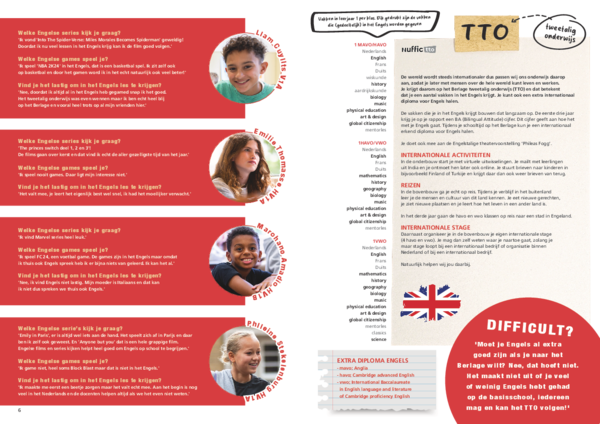
Berlage Lyceum is a fully bilingual school. This means that at MAVO, HAVO, and VWO levels, part of the lessons are taught in English.
From your very first lesson, you’re immersed in English, which helps you learn the language in a natural and, above all, fun way. By the time the Christmas holidays come around, it will feel like you’ve always been fluent in English!
How does it work?
At MAVO, you’ll have the following subjects in English:
Art & Design, Physical Education, Music, English, History, Biology, and Global Citizenship.
In the upper years, you’ll take the ANGLIA exam.
At HAVO, Mathematics and Geography are added to the above list.
At VWO, Science (chemistry and physics) is also added.
You complete lower secondary (HAVO/VWO 3) with a Cambridge Checkpoint Exam.
Subjects taught in English at Berlage Lyceum include:
- English
- Mathematics
- History
- Geography
- Science
- Biology
- Music
- Physical Education
- Art & Design
- Global Citizenship
Upper Years
In the upper years, you work toward the IB Diploma “English A: Language and Literature.”
Because the national final exams are in Dutch, most subjects return to Dutch from year 4 onward (HAVO and VWO), to ensure you're well-prepared for graduation.
At VWO, CULA (Culture and Arts) and Physical Education continue to be taught in English.
Note: All SE’s and CE’s (the national exams taken in all senior years) are taken in Dutch.
More, please!
Want to learn more about bilingual education (TTO) and whether it’s a good fit for you?
Visit: www.ikkiestto.nl
Curious what research says about TTO?
Check out this video: “For a long time, it was wrongly assumed that bilingual education was only for VWO students.” Read the article on nos.nl.
TTO in Practice
At Berlage Lyceum, approximately half of all subjects are taught in English at MAVO, HAVO, and VWO.
These lessons follow the CLIL method: Content and Language Integrated Learning. With CLIL, you learn both the subject matter and the language at the same time. This dynamic, activity-based method is generally a very effective way to learn. It helps you develop skills in listening, speaking, writing, and reading in English.
It takes some adjustment until the Christmas holidays, but you’ll quickly become more confident in learning a new language. In general, having a good attitude and work ethic is more important than having a strong prior knowledge of English.
TTO and Dyslexia
If you have dyslexia, you might wonder whether bilingual education is right for you.
Our experience is that bilingual education usually does not pose major problems for students with dyslexia. However, this does depend on the severity of the dyslexia. If Dutch is your first language, English spelling may not come naturally.
In addition to English, we also teach German, French, and Spanish.
So it's important that you enjoy new challenges, are willing to put in extra effort, and are excited about working intensively with the English language.